
Essential Tools Every Gunsmith Needs
Rage-inducing click-bait title for professionals of all stripes: I know.
You cannot reduce a cross-disciplinary field of nearly unlimited complexity down to a simple kit of gunsmithing tools; necessity will always encourage the acquisition or invention of additional tools to suit the problem at hand.
Best I can do is provide a list of beginner tools for specific purposes, and let nature take its course from there.
I write this for any gun owners who want to handle basic gunsmithing for their own guns. Congratulations – you’re now a gunsmith.
Assembly/Disassembly Tools
This is half the work, since it doesn’t matter what direction your smithery specializes in. You still have to take things down to the pins and springs.
It’s important to know: Due to the sheer volume of firearm manufacturers over the last two centuries, and the “Good Idea Fairy” present in the minds of engineers everywhere; proprietary tools exist. There’s a reasonable assortment that will handle a majority of needs, but we’ll get there presently.
The very first tool is a bench.
Optional? Sure, you could make do with a table (and I have. I do not recommend the table, but availability and necessity are what they are). The point is a dedicated, anchored, and immobile surface. Perhaps most visibly demonstrated with the “exploded view” that most armory manuals show; your average firearm is comprised of over a hundred individual pieces, and most of them are tiny.
This brings us to the second basic tool: Magnets.
No, I’m not kidding. It’s really that basic.
With time and practice, you can identify every individual component of a specific firearm model. If you haven’t been handling firearms for decades, odds are the gun a customer brings you will be one you’ve never seen before, and this is a reality you’ll never be without.
Magnets ensure that the tiny pieces you place down will remain exactly where you leave them, and this greatly helps differentiate them if they happen to look very similar. I’d suggest combining magnets with metal trays for extra security; wandering parts are a pretty lousy extra problem to have. Magnets on a stick are excellent for recovering springs and other components that can reach escape velocity under tension.
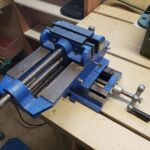
Yet another suggestion to further augment your primary tool: A bench vise for holding individual components.
Stable and immobile is a necessity for exerting force as needed, and there is no substitute. As an addition, there are soft jaws you can get that will prevent damaging finished surfaces.
I’d also like to mention: Adjustments to a component affixed to an assembled rifle often necessitate a tool for holding the entire rifle. Your bench vise might be able to do this, but I wouldn’t recommend it. I worked without a gun vise for a very long time. Owning one now, I never want to go back to the before times.
Now we can talk hand tools.
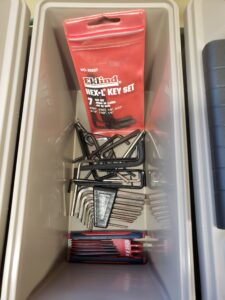
Bare bones is pretty simple: An assortment of Allen wrenches, both standard and metric.
This is hard to screw up on your part, but manufacturers love to do things like securing pistol grips via deeply recessed hex screws, which can complicate things. (*You may want to buy longer allen wrenches, generally*) To say nothing of some shotguns that secure the stock to the receiver via a deeply recessed hex *bolt* (the solution to which is naturally, a ratchet and an extender. You might consider these worthy acquisitions as well).
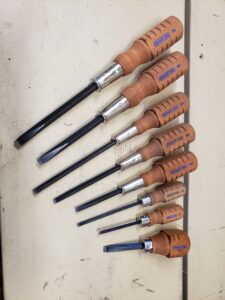
Screwdrivers: You’ll need ’em.
Whatever you just reached for, put ’em back. Not those ones.
Gunsmithing screwdrivers are machined to match the specific tolerances of the screws and steel we use to build our firearms. This means: They’re made of either S2 tool steel which is specially hardened, or they’re chromium-vanadium steel. The tips of the screwdrivers are precisely dimensioned to match the heads of the firearm screws, to help avoid slips that damage finish and prevent damage in either direction.
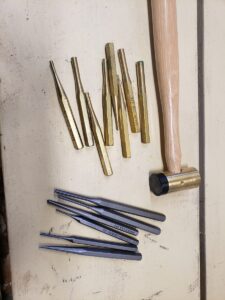
Finally, a good set of punches and a brass hammer.
Brass and steel punches respectively; they have different uses. It’s also useful to buy an assortment of pins (or even roll pins) for use as guides, or easy replacements.
Cleaning tools?
A short list of essentials, and a couple niceties.
Essentials: Nylon brushes, bore brushes, clean rags/cloth, and oil.
It doesn’t matter what it is that needs to be cleaned, it can be done reasonably well with those four things. I didn’t include an abrasive chemical component, as: If you’re cleaning even semi-regularly, the messes you have to resolve don’t need such an aggressive agent. (But by all means, have one on hand.)
Nitrile gloves are a strong recommendation.
They keep your hands clean, and help prevent accidental nicks from sharp metal edges.
Polymer picks are cheap and extremely useful for breaking up and pulling carbon out of recessed corners.
I endorse the usage of bore snakes. Yes, bore brushes are intended to correct copper, lead, (plastic from shotshell wadding,) and carbon buildup/fouling. Snakes help prevent that buildup through the owner’s periodic usage, and they do a reasonably good job in place of a bore brush if there isn’t any serious buildup. They’re an excellent time and effort saving solution both in the long and short term.
I’d also suggest brass brushes in case you find something caked in literal years worth of carbon. (I’ve had several folks bring firearms with barely functional gas systems that… I suppose worked well enough they didn’t know it needed cleaning.)
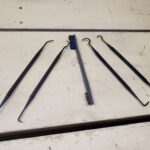
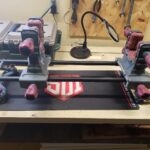
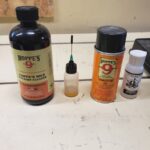
So, to recap the tools:
All-purpose tools.
- Bench
- Magnets(s)
- Vise(s)
- Allen Wrenches (standard and metric)
- Gunsmithing screwdrivers
- Punch set(s), and brass hammer
Cleaning tools.
- Nylon brushes
- Bore brushes
- Clean rags/cloth
- Oil
- Nitrile gloves
- Polymer picks
- Bore snake(s)
- Brass brushes
This is an excellent starting point and should address a majority of usage needs without extending out into specialty work.